
Fundamentals of Dehydration
The Ultimate Beginner’s Guide to Food Dehydration: Nature’s Best Preservation Secret
Ever wondered how those crispy apple chips, sun-dried tomatoes, or vibrant spice powders are made? The answer is food dehydration.
For the modern kitchen or the eco-conscious entrepreneur, dehydration is the ultimate way to reduce food waste and create healthy, 100% plant-based snacks. Let’s break down the essentials of “the art of the dry
What is Food Dehydration?
Food dehydration is the process of gently removing water from plant-based foods to prevent spoilage. Since the bacteria and mold that cause decay require moisture to survive, removing that water “pauses” the clock on freshness.
The Process:
Low Heat is applied to release water from the cells.
Controlled Airflow carries that moisture away from the food’s surface.
Benefits & Applications:
100% Nutrient Retention: Our machines use “Gentle Drying” technology. Unlike sun drying, which can destroy vitamins via UV rays, Jas Enterprise dehydrators use precise temperature control to preserve the natural enzymes and nutrients in fruits and vegetables.
Weight & Volume Reduction: Dehydration reduces food weight by up to 80-90%, significantly lowering your shipping and logistics costs—a major advantage for commercial exporters.
Concentrated Flavor Profile: By removing only the water, the natural sugars and flavors are intensified. This makes your final product (like spice powders or fruit leathers) taste superior to those processed with additives.
Hygienic Standards: Because our machines (like the SS304 Tray Dryer) are enclosed systems, your food is 100% protected from dust, insects, and environmental pollutants.
Dehydration vs. Drying: Is There a Difference?
While people often say “dried fruit,” there is a technical difference in how you get there:
| Feature | Sun Drying | Dehydration (Machine) |
| Consistency | Highly variable (weather-dependent) | Precise & Uniform results every time |
| Hygiene | Exposed to dust, birds, and insects | Enclosed, sterile environment |
| Nutrients | UV rays can degrade some vitamins | Controlled temps preserve nutrition |
| Speed | Takes days | Finished in hours |
What is a Dehydration Machine and How Does It Work?
A food dehydrator is a specialized appliance designed to mimic a warm summer breeze in a controlled box. It is significantly more efficient than a standard oven, which often gets too hot and lacks the necessary airflow.
How it works:
- Heating Element: Warms the air to a specific, low temperature.
- Circulation Fan: Moves the air horizontally or vertically across trays.
- Moisture Exhaust: Vents out the humid air so the food doesn’t “steam” itself.
Understanding Dehydration Machines: The Jas Enterprise Lineup
At Jas Enterprise, we manufacture industrial-grade solutions tailored to your production scale. We categorize our machines into two primary types:
Type 1: Batch Type (Best for precise, smaller to medium loads)
- 1A) Tray Dryer: The versatile “gold standard.” Produce is placed on trays, and hot air is circulated evenly. It’s perfect for fruits, ginger, garlic, and sliced vegetables.
- Capacity: Ranges from 5 to 220 trays.
- Temperature: Capable of reaching up to 300°C (572°F).
- Uniformity: Features a fan impeller with an axial flow design for better uniformity and quicker drying.
- Construction: Available in SS 304/SS 316, Aluminum, or Mild Steel, with optional flame-proof and spark-proof versions.
- 1B) Heat Pump Dehydration Machine: An energy-efficient powerhouse. It uses a heat pump to recycle air, making it ideal for delicate herbs and premium fruits that require lower temperatures to maintain color and aroma.
- Efficiency: Uses a reverse Carnot cycle to save over 40% energy compared to traditional drying.+1
- Quality: Ideal for low-temperature drying (30°C to 45°C), which is crucial for preserving the nutrition, essential oils, and color of specialty crops like herbs and premium fruits.+1
- Control: Equipped with a PLC + Touch screen system with sensors to track temperature and humidity across 10 different set periods.
Type 2: Continuous Type (Best for mass production)
- Designed for large-scale operations where the product moves through the machine on a conveyor system. This ensures a non-stop flow of dried goods like onion flakes or herbal grains, maximizing efficiency and labor savings.
- Output: Designed for mass production with capacities ranging from 250 kg to 900 kg per hour.+1
- Design: Features a multi-layer design with automatic rolling of material to ensure uniform heating.
- Safety: Operates as a dust-free, closed-loop process aligned with international health and safety standards.
Why Mechanical Dehydration Wins for Commercial Use
If you are producing for the market, sun drying is simply too risky. Mechanical dehydration provides:
- Standardization: Every batch of mango slices or spice powder looks and tastes the same.
- Food Safety: Consistent heat ensures the product is free from moisture-loving pathogens.
- All-Weather Production: You aren’t limited by the monsoon or winter seasons.
Moisture Content & Shelf Life
For a product to be “shelf-stable” (meaning it won’t rot without a fridge), you must reach a moisture content of 10% or less.
- Vegetables: 6–10 Months
- Fruits: 8–12 Months
- Herbs & Spices: 12–24 Months (when stored in a cool, dark place)
Pro-Tip for Jas Enterprise Clients: To ensure your batch is ready for the market, always use a Moisture Analyzer. Don’t guess by “feel”—commercial success depends on precise data!
Common Mistakes to Avoid
Based on our industrial experience since 1990, here are the most critical mistakes beginners make and how our technology solves them:
- Mistake 1: Using Excessive Drying Temperatures
- The Risk: Many beginners think higher heat means faster drying. However, excessively high temperatures can degrade a material’s structure, rendering it unsuitable for further processing. For specialty crops like herbs and fruits, low-temperature drying (between 30°C to 45°C) is crucial to maintain high commercial value.
- The Technical Solution: Jas Enterprise Heat Pump Dehydrators are specifically designed for low-temperature dehydration, which minimizes nutrient loss and preserves physical properties.
- Mistake 2: Poor Temperature and Humidity Monitoring
- The Risk: Failing to track conditions lead to inconsistent batches and spoilage.
- The Technical Solution: Our machines feature PLC + Touch screen controls with integrated sensors to track temperature and humidity in real-time. You can even set 10 different periods with specific temperatures and times for a single batch to ensure perfect results every time.
- Mistake 3: Neglecting Hygiene and Environmental Factors
- The Risk: Traditional sun drying relies on weather and exposes food to dust, insects, and UV radiation.
- The Technical Solution: Jas Enterprise provides dust-free, closed-loop processing. Our dehydrators safeguard products from UV radiation, precipitation, and pests, ensuring cleanliness and color are fully preserved.
- Mistake 4: Inconsistent Airflow (Uneven Drying)
- The Risk: “Wet spots” in a batch can cause the whole container to mold during storage.
- The Technical Solution: Our Tray Dryers utilize a fan impeller with an axial flow design for superior uniformity. For larger operations, our Continuous Conveyorized Dryers use a multi-layer design with automatic rolling of material to guarantee uniform heating across massive quantities.
Professional Applications (100% Vegetarian)
Our machinery is widely used across the following sectors to produce premium, shelf-stable products :
1. Fruits
Process everything from common staples to exotic varieties while maintaining color and flavor:
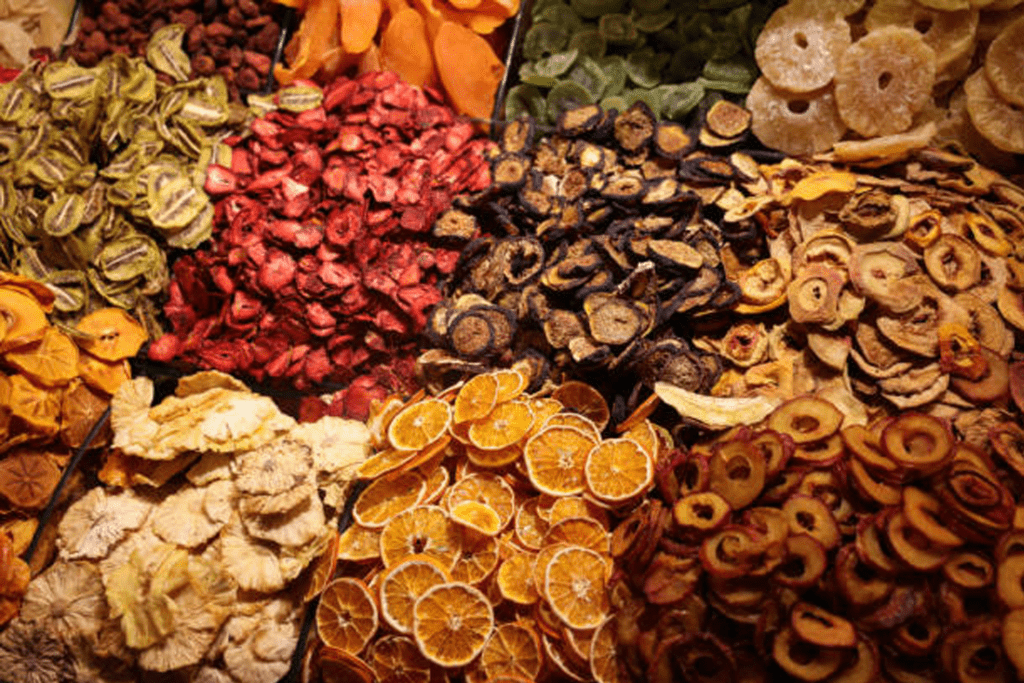
Staples: Red & Green Apples, Bananas, Mangoes, Pineapples, and Grapes (Raisins).
Berries & Small Fruits: Strawberries, Raspberries, Cherries, and Blackberries.
Exotics: Dragon Fruit (Pink Pitaya), Kiwi, Jack Fruit, and Avocado.
Specialty: Amla, Dates, Figs, and Coconut Water/Milk.
2. Vegetables
Create nutritious ingredients for instant soups, snacks, and catering:
Root Vegetables: Carrots, Potatoes, Beetroot, and Sweet Potatoes.
Alliums: Onions and Garlic (essential for spice powders).
Leafy Greens: Spinach, Coriander Leaves, and Mint.
Others: Okra, Bitter Gourd, Broccoli, Cauliflower, and Sweet Corn.
3. Herbs & Specialty Crops
Gentle low-temperature drying (30°C to 45°C) is used to preserve delicate essential oils :
Culinary Herbs: Basil, Oregano, Rosemary, Thyme, Parsley, and Dill.
Medicinal & Tea: Aloe Vera, Moringa Leaves, Tea, and Sage.
Flowers: Rose, Chrysanthemum, and Lavender.
4. Agriculture & Industrial Products
Fungi: Mushroom, Edible Fungus, and White Fungus.
Others: Noodles, Tobacco Leaf, and Incense.